
Schooner ML: The Ultimate Guide to Western Australia's Beer Sizes and Names
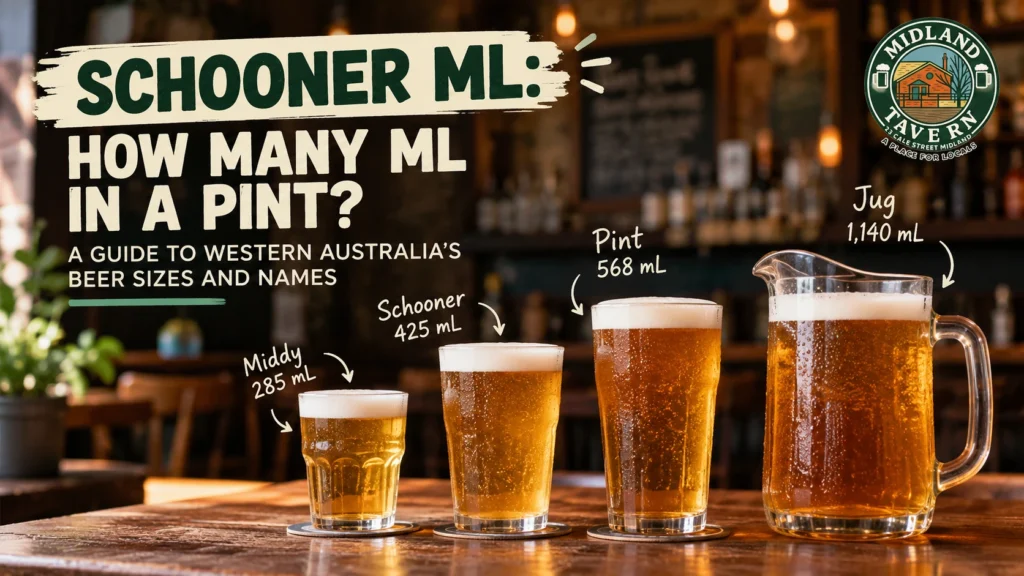
Table of Contents
A schooner in most Western Australian pubs holds 425 mL of beer. That makes it larger than a middy at 285 mL but smaller than an imperial pint at 568 mL, which many venues round to 570 mL.
If you searched for schooner mL, that is the quick answer. For beer drinkers in Western Australia, including locals and travellers trying to decode pub serving sizes, the detail matters because glass names are traditional rather than legal measurements, so the same word can mean a different amount in a different state.
This guide breaks down the common beer sizes used in WA, including schooner, middy, pint, jug, and other traditional glass names, then compares serves, standard drinks, legal measurement rules, and price value so you can order confidently, track how much alcohol you are drinking, and judge whether the pour is fair.
Disclaimer: Under the Liquor Control Act 1988, it is an offence to sell or supply liquor to anyone under 18. Please drink responsibly.
Australian Beer Sizes in Western Australia at a Glance
The table below lists the sizes you are most likely to see on a menu in Western Australia.
|
Serve |
Volume |
Notes |
|
Middy |
285 mL |
This is a small serve that other states often call a pot. |
|
Schooner |
425 mL |
This is a common serving size in Western Australia. |
|
Imperial pint |
568 mL |
This is the traditional pint, and menus usually round it to 570 mL. |
|
Jug |
About 1,140 mL |
This is a large vessel for sharing, and its capacity differs between venues. |
How Many mL in a Schooner?
The schooner size in Western Australia
A schooner in Western Australia usually holds 425 mL. It sits between the middy and the pint, making it a go-to size for ordering beer in a relaxed pub session with mates because you get more than a small glass without committing to a full pint. If you have a preferred serving size, ask for a schooner, middy or pint instead of assuming which size the venue will serve.
Why the name changes between states
The word schooner is a serving name and not a measurement set by law. In New South Wales it also means 425 mL, but in South Australia a 285 mL glass is commonly called a schooner, and the 425 mL glass is called a pint. A traveller who orders a schooner in Adelaide will therefore usually receive a smaller glass than they would in Perth.
Victoria and Queensland add to the confusion by calling the 285 mL serve a pot, while in Tasmania the same size is also called a ten, and Western Australia and New South Wales call it a middy. For a 285 mL pour, these names differ by region, but pot, middy, and handle are all generally accepted in different places. Beer size naming varies across the country and can leave travellers confused when the same name refers to different volumes.
How Many mL in a Pint?
The imperial pint
An imperial pint is defined as 20 imperial fluid ounces, or 20 fl oz, which equals about 568 mL. Most venues round this to 570 mL on their menus, the most common size people expect when a venue lists an imperial pint this way. So the answer to how many mL are in a pint is about 568 mL, or 570 mL when it is rounded. For a sense of scale, a pint is about twice the size of a middy.
Imperial pint versus US pint
A US liquid pint is smaller, at about 473 mL, which is 95 mL less than an imperial pint. This matters when you read an American recipe or a drinks chart from overseas, because the same word describes two different amounts.
Pint vs Schooner: What Is the Difference?
The difference between a pint and a schooner is simply the amount of beer poured into the beer glass. If you use 570 mL for the pint and 425 mL for the schooner, the pint holds 145 mL more.
That means a pint contains about 34% more beer than a schooner. Looked at the other way, a schooner is about 75% of a pint, which is closer to three-quarters than to two-thirds. The larger or smaller size can also affect how refreshing the drink stays and how much flavour you notice before it warms up.
The extra 145 mL is roughly half a middy, so the gap is noticeable without being huge.
Middies, Jugs, Ponies and Bobbies
Schooners and pints are the best-known sizes, but you may hear a few other terms in an Australian pub.
Middy
A middy holds 285 mL, which is very close to half of an imperial pint. It suits people who want a colder beer and prefer quality over quantity without committing to a larger glass, and it is handy when you want to try a new brew or a bold ale in one visit.
Jug
A jug is the standard 1,140 mL beer size for sharing across Australia, and among Australian beer sizes it is one of the more consistent ways to order beer in Australia. It is a common option for a group at the pub and helps you order for the table like a local. A jug of about 1,140 mL sits within the usual range of serves and equals two 570 mL pints, four middies or a little under three schooners.
Pony and bobbie
Pony and bobbie, which is sometimes spelt bobby, are older names for small serves. Some lists place the pony at around 140 mL, but usage and volumes vary from place to place, and the bobbie is even less consistent. These names are now rarely seen on modern menus.
How Many Standard Drinks Are in a Schooner or Pint?
The size of the glass tells you how much liquid you are getting, but it does not tell you how much alcohol is inside, because that depends on the strength of the beer; style matters too, since a beer with more hops or a fuller flavour only changes the standard-drink context through ABV, not glass size. One Australian standard drink contains 10 grams of pure alcohol, and the Healthy WA guide to standard drinks explains how this works in more detail.
The figures below are calculated examples, so the real number for a particular beer will differ slightly.
|
Serve |
Alcohol strength |
Approximate standard drinks |
|
Middy (285 mL) |
4.8% |
1.1 |
|
Middy (285 mL) |
3.5% |
0.8 |
|
Schooner (425 mL) |
4.8% |
1.6 |
|
Schooner (425 mL) |
3.5% |
1.2 |
|
Schooner (425 mL) |
2.7% |
0.9 |
|
Imperial pint (570 mL) |
4.8% |
2.2 |
|
Imperial pint (570 mL) |
3.5% |
1.6 |
How to work it out yourself
To calculate standard drinks yourself, multiply the volume in litres by the alcohol percentage and then by 0.789. A 425 mL schooner of 4.8% beer works out as 0.425 × 4.8 × 0.789, which is about 1.6. The label on the bottle or the bar team can tell you the beer’s strength.
What the guidelines recommend
The NHMRC Australian alcohol guidelines advise healthy adults to have no more than 4 standard drinks on any one day and no more than 10 in a week. They also advise that people under 18 should not drink alcohol. Anyone who plans to drive is safest not drinking at all.
How Much Is a Pint of Beer?
The price of a pint depends on the venue, the style of beer and the size of the serve, so no single price applies across Western Australia.
In Australian beer pricing, costs can also differ sharply from WA to cities like Sydney and Melbourne, which are often cited among the most expensive in the world for a pint. The fairest way to compare prices is to work out the cost of every 100 mL. To do this, divide the price by the volume in millilitres and multiply the answer by 100.
A $9 beer in a 570 mL glass costs about $1.58 per 100 mL, while a $7.50 beer in a 425 mL schooner costs about $1.76 per 100 mL. These are examples rather than real menu prices, but they show that a bigger glass can cost more overall and still be better value for each millilitre, even if that is not always the serve your bartender would assume you want because price and preference both matter.
You can see what we serve on our menu.
How Pubs Must Measure Beer
Because glass names are not official, the law focuses on volume instead. Under Australian trade measurement rules, beer must be sold at a price determined by volume.
The Australian Government’s guide to selling alcohol explains that beer on tap is usually served in an approved, batch-tested glass or jug that is marked with its volume in millilitres or litres.
A glass’s capacity can be set either by the brim or by a fill line known as a Plimsoll line, and venues that do not use approved glassware must advertise the actual capacity of the container. This means you should be able to find out what a serve holds, either from the marked glass or from the capacity the venue advertises.
Enjoy a Drink at Midland Tavern
Now that you know the difference between a middy, a schooner and a pint, ordering should feel much easier. If you would like to put that knowledge to use, you are welcome to visit Midland Tavern Sports Bar & Grill.
You can relax at the bar or book a table for your group. We also host functions, and if you have any questions, please contact us.
Frequently Asked Questions
Is a schooner the same as two middies?
No. A 425 mL schooner is approximately one and a half 285 mL middies. In WA, two middies total 570 mL, which is approximately the volume of a 570 mL imperial pint, but not every state uses the same name for the same volume. For example, in nsw, a schooner also means 425 mL. A schooner therefore contains less beer than two middies.
How many schooners are in a litre?
One litre (1,000 mL) contains approximately 2.35 schooners, assuming each schooner holds 425 mL. That is two full schooners, totalling 850 mL, with another 150 mL remaining. The comparison is based on volume, not the number of glasses a venue serves.
Why do two schooners sometimes look different?
Glass shapes vary between venues, and a glass can be marked to the brim or to a fill line. Two glasses with the same marked volume can therefore look quite different, so the marked volume is more reliable than the shape.